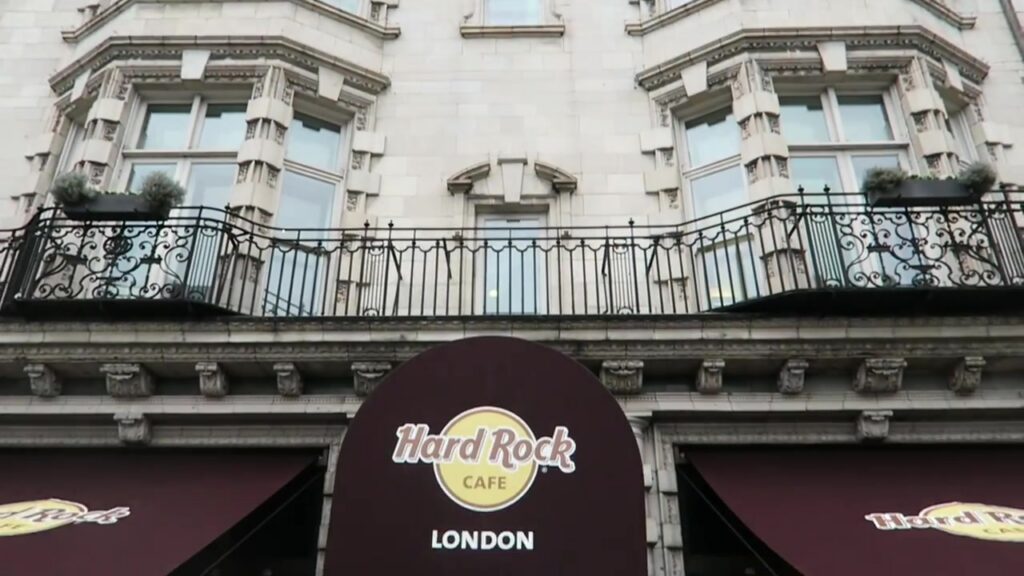
A Roberts London film from 2017 visits the original Hard Rock Cafe on Old Park Lane, explores its rock-and-roll memorabilia and basement vault, tries the special chilli menu and walks through Green Park to Buckingham Palace.
The Hard Rock Cafe is now an international name, but its story began in London. The first cafe opened on Old Park Lane in 1971, placing American-style food and rock-and-roll culture within sight of Hyde Park Corner and Buckingham Palace.
This Roberts London film records a visit on 26 February 2017. Barry approaches from Victoria, enters the original cafe, examines the collection and crosses the road to the Rock Shop, where a guided descent leads into the memorabilia vault. The second half of the visit returns to the restaurant for cocktails and a special chilli menu before continuing through Green Park to Buckingham Palace.
The film is an archive of the cafe, displays and menu as they appeared in 2017. Memorabilia locations, access arrangements and food offers can change, so the visit should not be treated as current visitor guidance.
Walking from Victoria to Old Park Lane
The day begins outside Victoria station. Rather than arriving directly at Hyde Park Corner, Barry walks through Belgravia towards the original Hard Rock Cafe on Old Park Lane.
The approach gives the visit a strong London setting. Buses, hotels and broad roads gradually give way to the edge of Mayfair, with Green Park and Hyde Park close by. The cafe appears beneath a curved awning on the ground floor of an ornate stone building.
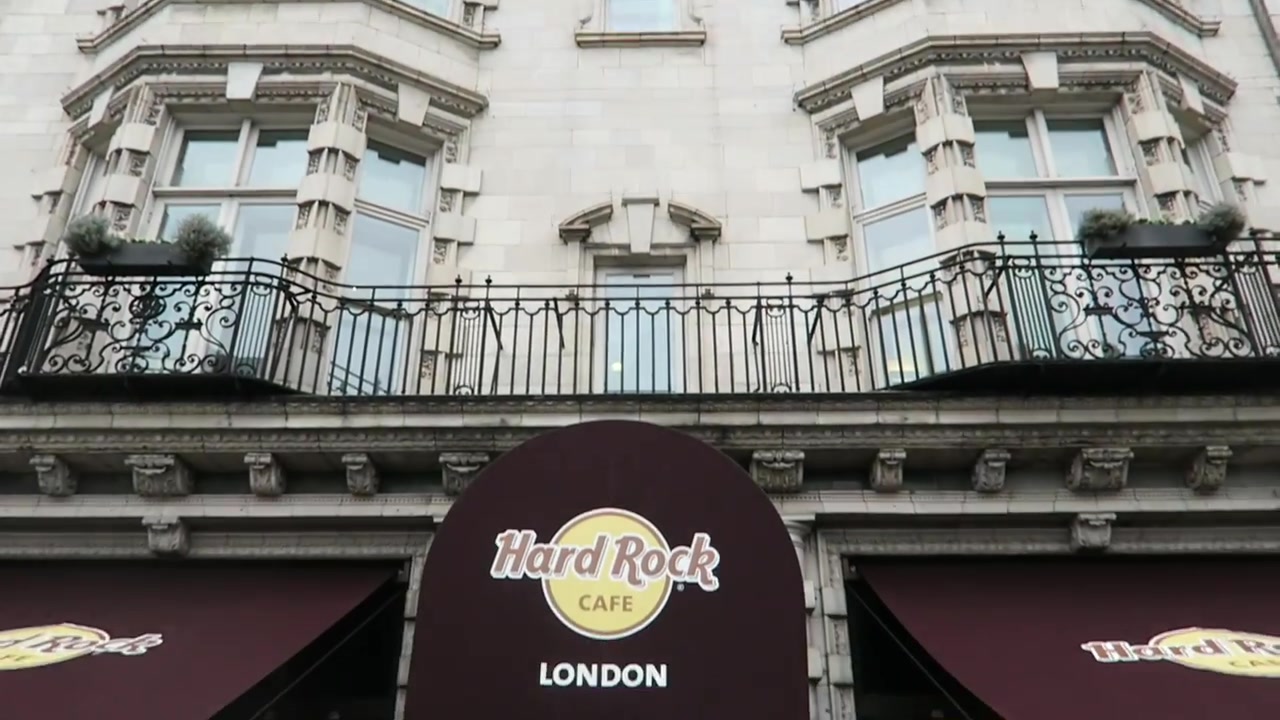
Its exterior is relatively restrained compared with the scale of the brand it created. The Hard Rock name, the London inscription and the building above are enough to establish the location without the monumental architecture used by some later venues.
The original Hard Rock Cafe
Peter Morton and Isaac Tigrett established the first Hard Rock Cafe in London in 1971. The combination of informal American food, music and memorabilia later became an international formula, but Old Park Lane remains the starting point.
The collection is central to that history. Eric Clapton supplied a guitar for display above his preferred bar stool; Pete Townshend followed with another. What began as an exchange between musicians developed into a much larger collection of instruments, clothing, lyrics, awards and personal objects.
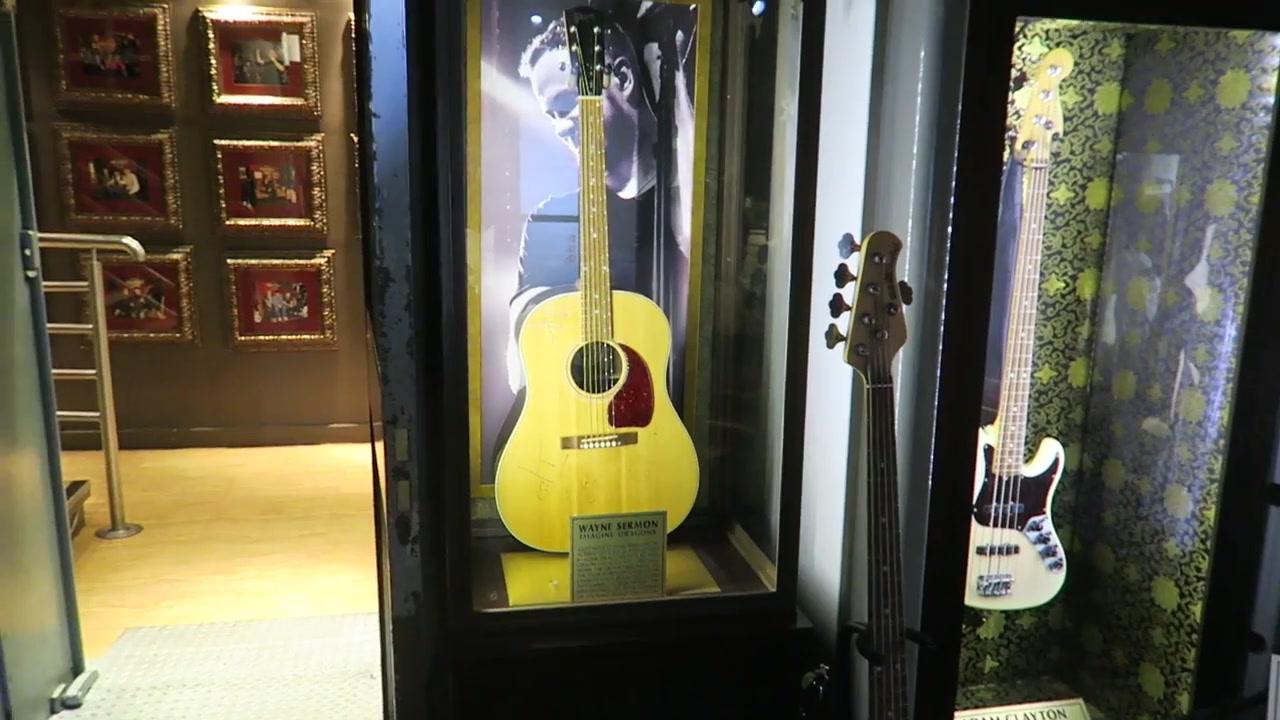
Barry first looks around the cafe itself, where framed pieces and guitars surround the dining room. The displays make music history part of the restaurant rather than separating it into a conventional museum gallery.
Crossing to the Rock Shop and the vault
The film then crosses Old Park Lane to the Rock Shop. Beneath the retail floor is the Vault, a compact room created inside the former strong room of a bank.
The descent changes the atmosphere immediately. Bright shop lighting gives way to a narrow staircase, dark walls, locked doors and closely arranged cases. A guided visit reveals how much material has been fitted into a relatively small space.
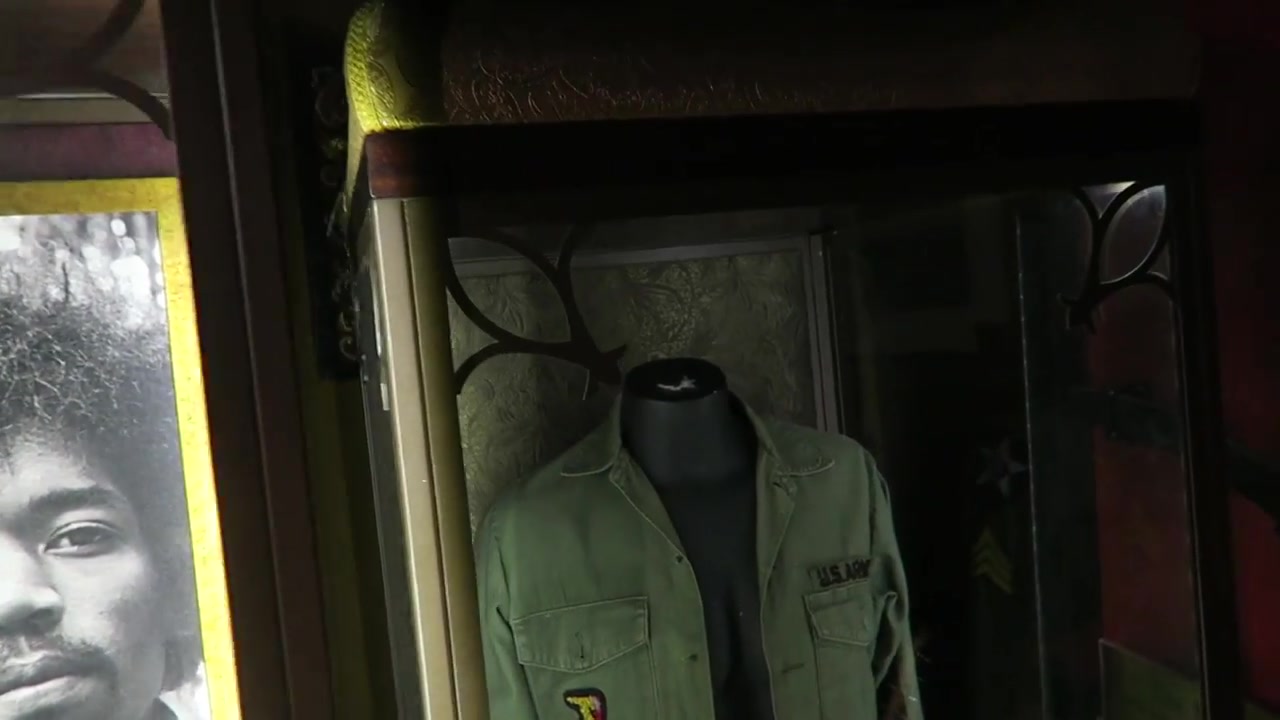
Guitars, stage clothing and handwritten documents sit within inches of one another. The film pauses over instruments associated with major British and American musicians, including displays presented during the tour as connected with Eric Clapton, Pete Townshend, The Who and Jimi Hendrix.
One of the most striking objects is the custom Gibson Flying V associated with Jimi Hendrix and his 1970 Isle of Wight appearance. Its unusual shape is instantly recognisable even among a room full of guitars. Nearby clothing, portraits and cases turn individual objects into compact biographical displays.
John Lennon and the handwritten record
Beatles material forms another important part of the visit. The camera studies a John Lennon display and a plaque identifying material connected with “Instant Karma!”, written and recorded in January 1970.
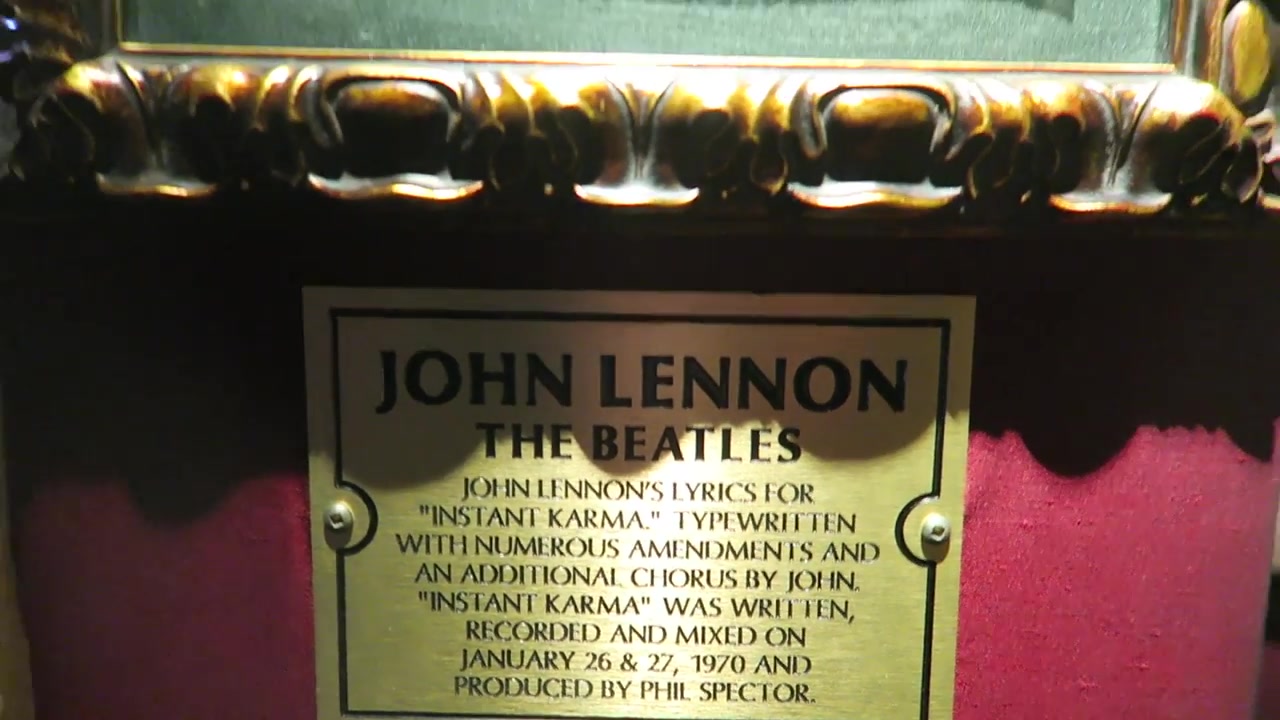
Handwritten documents have a different presence from instruments or stage costumes. A guitar can be recognised as a performance object, while lyrics and working notes bring the viewer closer to the private process behind a finished recording.
The value of the vault lies in these contrasts. Famous names provide the initial attraction, but the small details—labels, wear, handwriting and the relationship between objects—reward a slower look.
Cocktails and the chilli menu
After the vault tour, the film returns to the restaurant. Barry begins with a cocktail before turning to a limited chilli menu built around different heat levels.
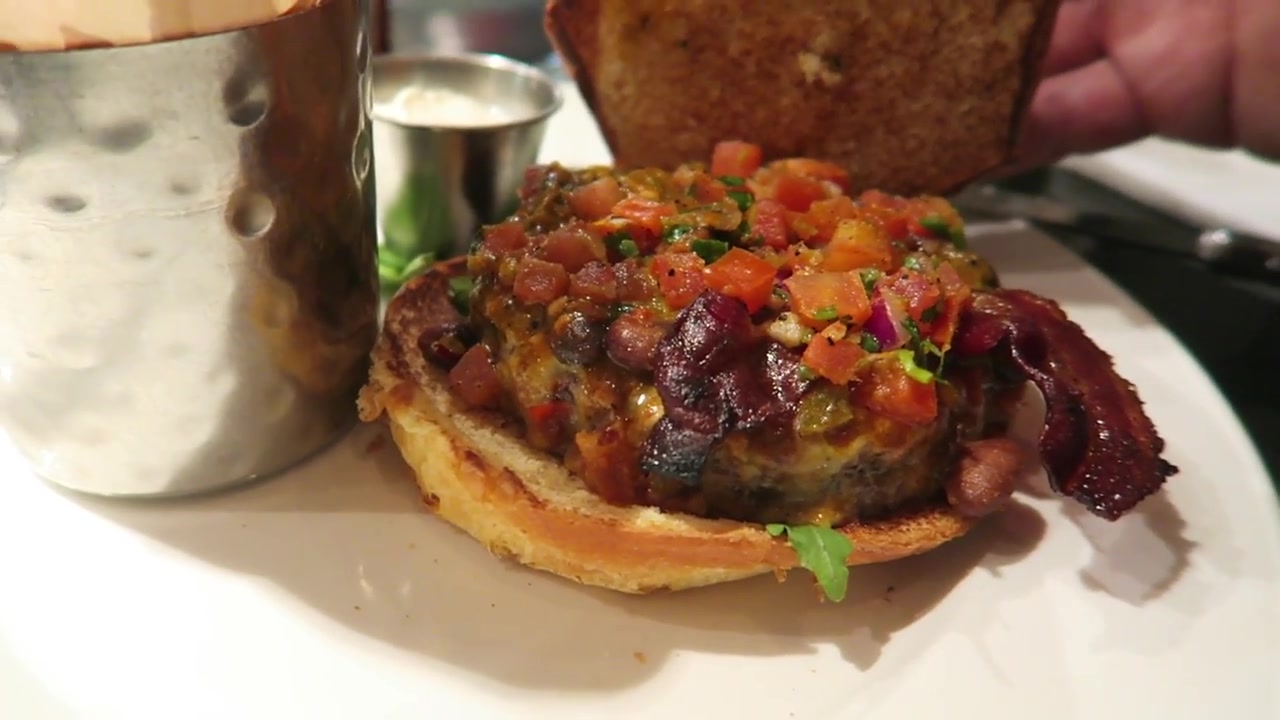
The main dish is a burger topped with a generous chilli mixture, served with fries. The close view shows beans, peppers and chopped garnish over the patty, making it one of the film’s strongest food images. Barry tests the heat as he eats rather than treating the menu’s warning as decoration.
Dessert continues the theme with a dark chocolate dish and ice cream. The restaurant sequence is deliberately leisurely after the density of the vault: the camera moves between food, drink and the memorabilia surrounding the tables.
The menu belongs specifically to the 2017 visit. Its dishes, names and heat claims are preserved here as part of the film rather than offered as a description of what is served today.
More memorabilia in the dining room
The tour does not end when Barry leaves the vault. The restaurant walls contain further guitars, framed records, clothing and awards, allowing the collection to continue around the meal.
Among them is a recording-industry award connected with the Beatles’ “Yellow Submarine”. Other cases combine instruments with photographs and descriptive plaques. These displays are more open and dispersed than the basement collection, becoming part of the visual rhythm of the dining room.
This is what distinguishes the original Hard Rock Cafe from a restaurant with a few decorative references to music. The collection shapes the entire experience, from the bar and tables to the shop and the secured room below it.
Through Green Park to Buckingham Palace
Leaving Old Park Lane, Barry walks into Green Park. The shift from the dark, object-filled interiors to the open paths and winter trees is abrupt.
The route continues south-east towards Buckingham Palace. Cyclists and pedestrians share the broad path before the palace appears beyond the park gates and traffic on Constitution Hill.
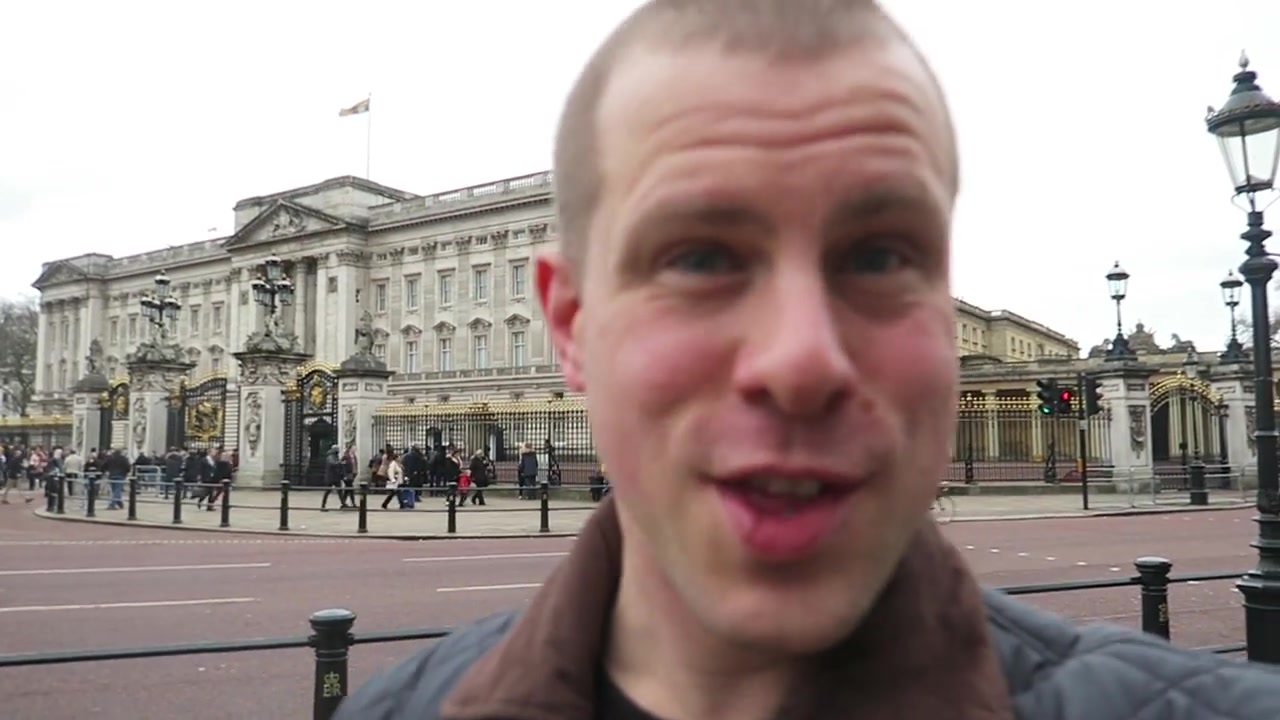
Barry closes the film with Buckingham Palace behind him. It is a useful geographical reminder: the original Hard Rock Cafe is not an isolated themed destination but part of a central London walk linking Victoria, Belgravia, Hyde Park Corner, Green Park and the royal quarter.
A London music institution in 2017
Seen as an archive film, the visit captures several layers of the Hard Rock idea at once. There is the original 1971 London location, the story of a collection that began with musicians’ guitars, the compressed spectacle of the Vault and the familiar restaurant experience built around burgers and cocktails.
The most memorable section is the descent beneath the Rock Shop. Within a small former bank vault, objects associated with some of the most influential figures in popular music are placed close enough to reward careful viewing.
The walk to Buckingham Palace completes the London setting. The result is not simply a restaurant review or a museum tour, but a record of how music memorabilia, food and the surrounding city formed one Roberts London day in February 2017.
